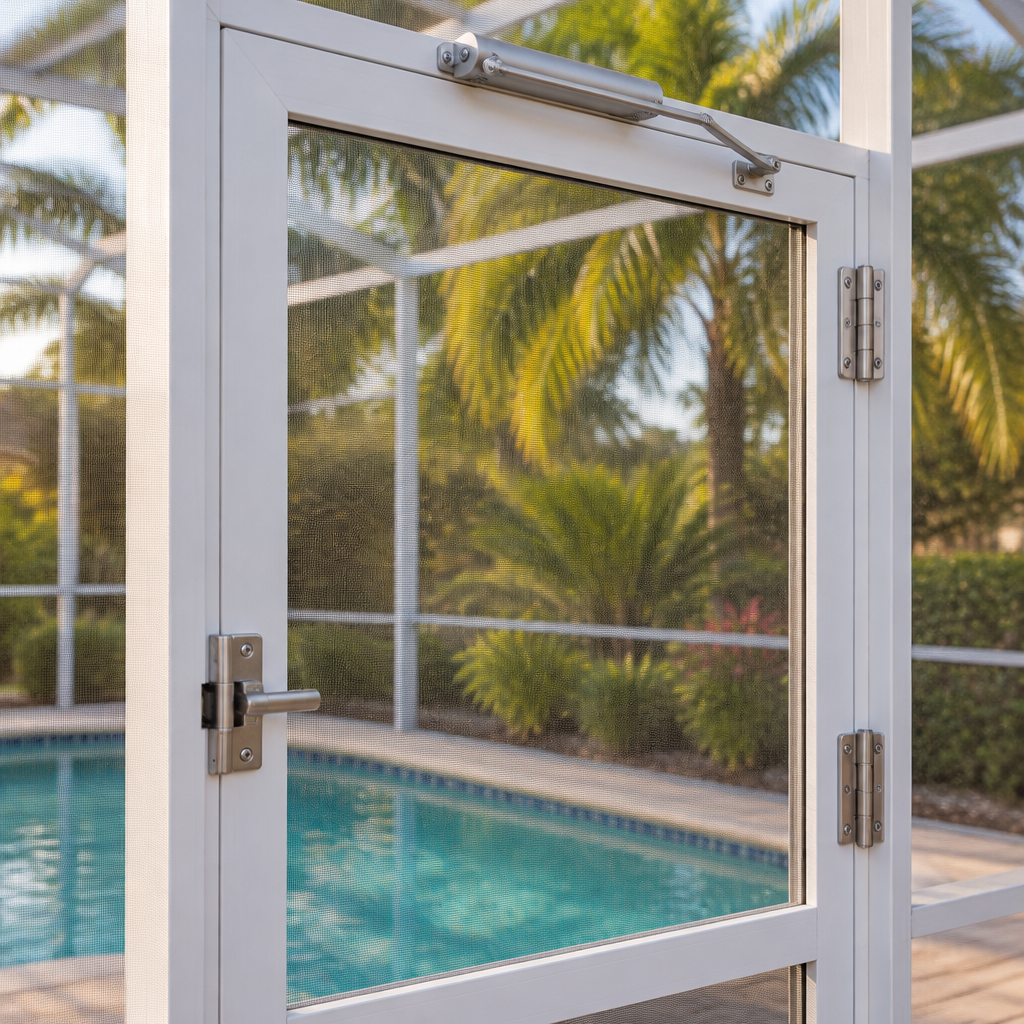
Direct answer: Screen door repair and replacement in Apollo Beach comes down to five parts: the closer, the hinges and their screws, the rollers and track on a slider, the latch and strike, and the mesh at the push point. Four of those five are a hardware job that can be done with the door still hanging. The fifth question, and the one people skip, is whether the door still closes and latches on its own, because on a pool cage that is not a comfort feature. It is the safety feature the pool was signed off on.
What actually fails on a screen door?
Screen doors are simple machines with a hard life. They sit in salt air, they get pushed open with one hand a few thousand times a year, and they hang off a frame made of thin-wall aluminum that was never designed to hold a screw under load forever. Failure is predictable, and it happens in the same order almost every time.
The closer. On most South Shore enclosures this is a spring closer or a small hydraulic unit mounted at the top of the door. Springs lose tension as they age, and hydraulic closers leak oil past the seal and stop controlling the last few inches of travel. The door still shuts if you push it. It just does not shut itself, which is the whole point.
The hinges and the screws. Aluminum frame, steel screw, salt air: the two metals disagree and the aluminum gives first. The screw holes wallow out, the door sags at the top corner, and then it drags the bottom corner on the sill. By the time it is dragging, the hinge is not the only problem. Most of these are repairable with larger fasteners or a rivet, but only if the frame is still straight.
Rollers and track, on sliders. A sliding screen door rides on two small wheels in a track that collects sand, pollen, and leaf grit. The wheels flat-spot, the track fills, and the door starts jumping and binding. Heavy-duty rollers with sealed bearings are cheap and they are the single best upgrade on a slider.
The latch and strike. The tongue gets bent, the strike plate loosens its two screws, and the door stops staying shut. On a pool enclosure this is the part that matters legally, and it is covered further down.
The mesh at the push point. Mesh does not fail evenly. It fails where a hand pushes it, right beside the handle, and then it runs. A single panel is a small repair. Failure across most of the door means the panel is done, and if the frame around it is already soft at the screw holes, the door is done with it.
When can a screen door be repaired, and when does it have to be replaced?
The decision rule is short: if the door cannot be made to close and latch on its own after new hardware is installed, replace it. Everything else is a judgement call on cost.
Repair is the right first answer when the frame is straight and square, the mesh is sound except at one or two spots, and the hardware can be changed with the door hanging. That covers the large majority of calls, and it is usually the same visit.
Replacement is the answer in four situations:
- The frame is twisted or bowed. A door that no longer sits in the plane of its opening will not stay latched, no matter what hardware goes on it.
- The screw holes are stripped past repair. When every hinge point needs a patch plate, the labor of saving the door approaches the price of a new one.
- The bottom rail is rotted or crushed. Common on doors that have been dragging on a wet sill for two seasons.
- The opening itself has moved. On an older cage, a post or header that has shifted means the door was fitted to an opening that no longer exists. That is a frame conversation, not a door conversation.
One thing worth saying plainly: a door on a permitted pool enclosure is not the same product as a patio slider from a box store. It has to carry self-closing and self-latching hardware that satisfies the statute, and it has to be fitted to an opening that was engineered for a specific wind load. Swapping in the wrong door to save a hundred dollars creates a bigger problem than the one you started with.
How does Florida pool barrier law apply to a screen door?
This is the section most homeowners have never been told, and it is the reason a $150 closer is worth taking seriously.
Under Florida Statutes 515.27(1), a residential pool has to have at least one safety feature to pass final inspection, and a permitted enclosure that meets the barrier requirements of s. 515.29 counts as one. On a great many South Shore pools, the screen enclosure is that feature. There is no separate fence. Nothing else stands between the house and the water.
What s. 515.29 then asks of the enclosure:
- s. 515.29(1): the barrier must be at least 4 feet high on the outside, and it may not have gaps, openings, indentations, protrusions, or structural components that could let a young child crawl under, squeeze through, or climb over it.
- s. 515.29(3): gates that provide access to swimming pools must open outward away from the pool and be self-closing, equipped with a self-latching locking device. The release mechanism has to be on the pool side of the gate and placed so a young child cannot reach it over the top or through any opening or gap.
- s. 515.29(5): the barrier may not be positioned so that any permanent structure, equipment, or similar object can be used to climb it. That is the storage question, and it is why a cooler parked against the cage matters.
One common mix-up, because the numbers get repeated loosely online: s. 515.27(1)(d) is about the doors of the house that give direct access to the pool. Those need a self-closing, self-latching device with the release mechanism no lower than 54 inches above the floor. That 54-inch figure is a house-door provision. It is not the rule for the enclosure gate, and it is not a latch height you can simply apply to a cage door and call it compliant.
Here is the practical consequence. The moment a screen door stops closing and latching on its own, the enclosure has stopped being the safety feature the pool was signed off on. Not because an inspector is coming, but because the thing performing the function is no longer performing it. A sliding screen door with no self-latching hardware, a closer that has lost its tension, a latch with a bent tongue: all three of those are code and liability problems wearing the costume of a minor annoyance.
If your pool was permitted with a separate barrier fence and the enclosure is not carrying that job, the door still matters, but it is a comfort and pest question rather than a barrier one. Worth knowing which situation you are in before you decide how much to spend. If you are not sure, the permit history at Hillsborough County will tell you, and so will the final inspection paperwork from when the cage went up.
What does screen door repair and replacement cost in Apollo Beach?
These are typical installed ranges for this market in 2026, not a quote. Every one of them moves with the size of the door, the condition of the frame, and whether the hardware has to satisfy a pool barrier.
- Hardware-only repair (closer, hinges, rollers, latch, re-hanging and adjusting a door): roughly $95 to $225, and most of that is the trip and the labor rather than the parts.
- New single screen door, standard aluminum, installed on a patio or lanai with no pool underneath: roughly $275 to $450.
- New screen door on a permitted pool enclosure, with self-closing and self-latching barrier hardware and a proper fit to the engineered opening: roughly $350 to $650.
- New mesh in an existing door while the hardware is being serviced: a small add-on rather than a line item, and the cheapest thing on this list.
Two things push a job toward the top of those ranges: a door that has to be custom-sized to an opening that is out of square, and a cage where the door is integral to a larger panel replacement. Two things keep it at the bottom: a frame that is still straight, and hardware that is standard enough to be on the truck.
What you should not accept is a price that skips the barrier question entirely. If a contractor quotes a replacement door on a pool cage and never asks whether the enclosure is the barrier, that is a sign they are selling doors rather than solving the problem.
Which parts and hardware are worth specifying?
The hardware on a screen door is where a repair either lasts five years or eighteen months. These are the choices that matter:
- Self-closing hinges versus a hydraulic closer. Spring hinges are simpler and fine on a light door with light traffic. A hydraulic closer gives consistent shut force on a heavier or wider door, and it is adjustable, which matters on a door that has to reliably latch.
- Stainless or coated fasteners. On a lot close to the bay, plain steel screws are a two-year decision. Stainless or coated fasteners are the reason a door stays tight.
- Heavy-duty rollers with sealed bearings on any slider. Grit kills cheap wheels, and sealed bearings are the difference between a door that glides and a door that gets lifted shut.
- A latch with a real strike plate, not a tongue catching the frame edge. On a barrier door the latch has to engage positively every time, not sometimes.
- Mesh grade. Standard 18x14 fiberglass is the baseline for most enclosures. 17x20 no-see-um is the answer where biting midges are the complaint, at the cost of some visibility and strength. Pet screen resists dogs and cats pushing through. Super screen is the heavier option for high-traffic doors and impact zones. The full trade-off between frame and mesh materials is covered in our comparison of aluminum versus fiberglass screen enclosures.
What should a homeowner check in five minutes before calling?
None of this needs tools, and all of it is useful to whoever shows up:
- Open the door halfway, let go, and watch. It should close and latch on its own. If it stalls, drifts, or needs a nudge, the closer or the hinges are the reason.
- Look at where the latch release sits. On a pool cage gate it belongs on the pool side, high enough that a small child cannot reach it over the top or through a gap.
- Put a hand on the hinges and try the screws. Loose or spinning screws mean the frame is starting to let go, and that is cheaper to fix now.
- On a slider, lift the door slightly by the handle. Play means worn rollers. A grinding sound means the track needs cleaning before it needs parts.
- Check the gap at the strike. A visible gap with the door shut is a latch alignment problem, and it usually means the door has sagged.
- Look at what is stored beside the enclosure. Anything climbable within reach of the cage is a barrier violation under s. 515.29(5), and moving it costs nothing.
If steps 1 and 2 both fail, stop reading and get it looked at. That combination is the one that turns a maintenance item into a safety problem.
Frequently asked questions
How much does a pool cage cost in Apollo Beach FL
It depends on the footprint, the roof style, the mesh grade, and the design wind speed at your address, which is why two bids on the same pool can be 30 percent apart and both be honest. Our screen enclosure cost guide for South Shore lays out the current local ranges and what drives each one.
Pool cage builder in Apollo Beach FL
A pool cage builder measures the existing deck or slab, engineers the aluminum frame for the wind load at that address, pulls the Hillsborough County permit, and installs the mesh. Our page on pool cage builders in South Shore covers what the build involves, and permitting a screen enclosure in Hillsborough County covers the inspection sequence.
Soffit and fascia contractor in Apollo Beach FL
Soffit and fascia work covers the roof edge: the vented panels under the eaves and the trim board the gutter hangs from. It is usually taken on at the same time as an enclosure because the two share the same attachment points and the same ladder. Ask for a written scope, because "soffit and fascia" means different amounts of work to different contractors.
Concrete driveway contractor in Apollo Beach FL
A concrete driveway contractor handles subgrade prep, forms, reinforcement, the pour, and the finish. On the South Shore the schedule is set by the rainy season as much as by the crew. Our concrete driveway cost guide covers what a broom finish runs per square foot and what changes the number.
Pool cage repair near me
Pool cage repair starts with a site visit to separate torn mesh from damaged structure, because those are two different jobs with two different permits. Storm-related damage has its own sequence, covered in what to do after a storm damages your screen enclosure.
Lanai screen repair in Ruskin FL
Lanai screen repair in Ruskin follows the same steps as Apollo Beach: new mesh panels, hardware service, and a check that any self-closing feature still functions. The difference is that a lanai with no pool underneath is not carrying a barrier obligation, so the hardware conversation is about convenience. Our guide to when and how to rescreen a lanai covers the decisions.
Getting it looked at
A screen door is the cheapest thing on an enclosure to fix and the fastest thing to turn into a real problem. If the door does not close and latch on its own, or the latch sits where a child can reach it, that is worth a visit this week rather than next month. Southern Legacy handles screen door repair, door replacement, and full rescreens across Apollo Beach, Ruskin, Sun City Center, and the rest of the South Shore, and we will tell you honestly when a repair is the right answer and when the door is finished.