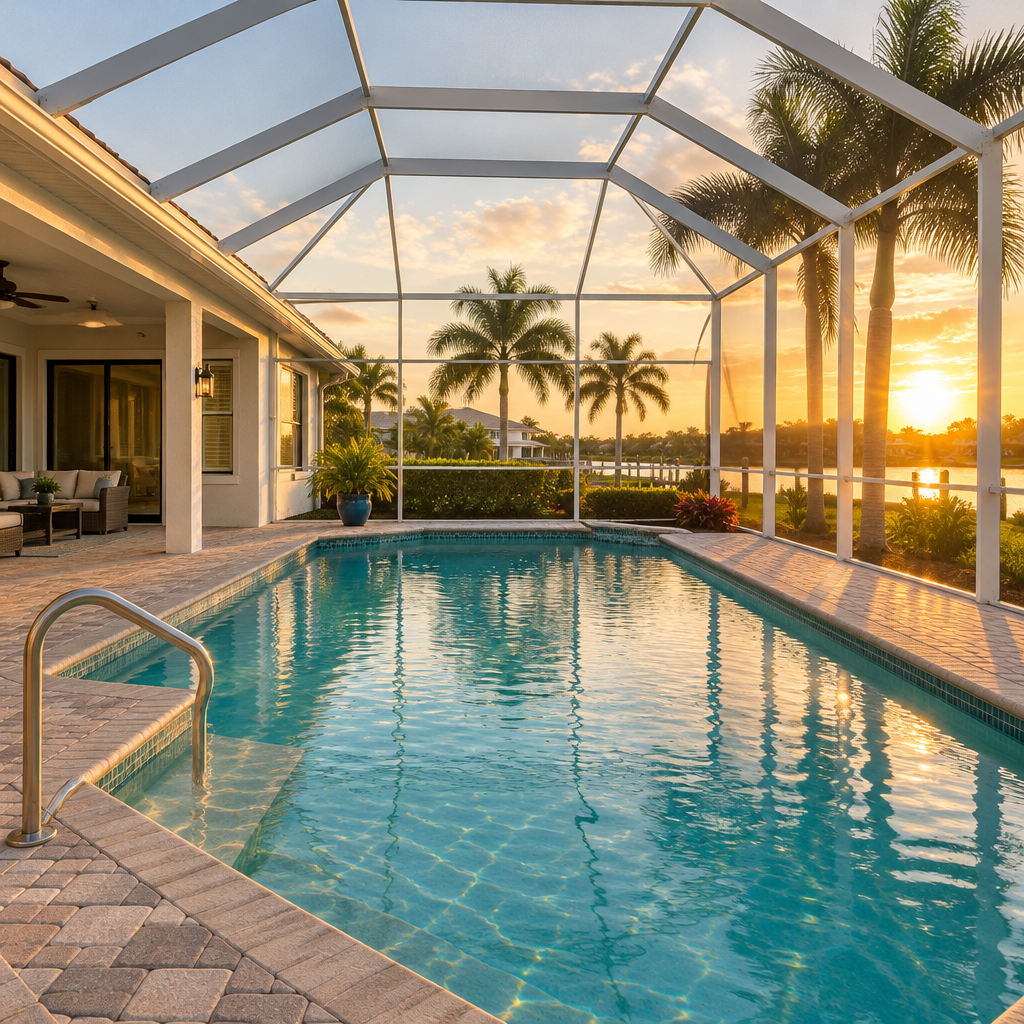
Direct answer: In Florida, a pool cage and a screen enclosure are the same product under two names. "Pool cage" is the local shorthand for a full aluminum-framed, screen-covered structure built over a swimming pool. "Screen enclosure" is the broader category, and it includes the same structure over a patio, lanai, or outdoor kitchen where there is no pool underneath. The frame, the mesh, the engineering, and the permit all come from the same playbook. What changes is what sits inside it, and that changes the code you have to satisfy.
Why South Shore Homeowners Hear Both Words
Drive through Apollo Beach or Ruskin and every enclosure on the block looks like the others: aluminum posts, a screen roof, a screen wall facing the water or the yard. The trade talks about them by what they cover. A crew building over a pool says cage because the shape wraps the pool like one. A crew building over a paver patio with a television and a bar says lanai or screen enclosure, because there is no pool to cage.
The confusion is worth clearing up before you collect estimates, because a contractor quoting a "screen enclosure" and a contractor quoting a "pool cage" may be bidding two different scopes and you would never know from the totals.
Where the Difference Actually Costs You Money
1. Pool barrier law applies to one and not the other
Florida's Residential Swimming Pool Safety Act requires a new residential pool to have at least one safety feature, and a permitted enclosure that meets the barrier requirements counts as one. Statute 515.29 sets the details that matter: the barrier must be at least 4 feet high on the outside, it cannot have gaps, openings, or structural components a young child could crawl under, squeeze through, or climb over, and any gate giving access to the pool must open outward away from the water and be self-closing with a self-latching device positioned on the pool side, out of a child's reach.
That last clause is where cheap enclosures fail. A cage with a standard sliding screen door, or a gate whose latch sits on the outside face, may be perfectly good at keeping insects out and still not satisfy the barrier requirement. If the enclosure is the only thing between your house and the water, the door hardware is a code question, not a preference.
A screened lanai with no pool in it triggers none of this. There is nothing to isolate, so the hardware is whatever you want it to be.
2. The permit scope is not the same
Hillsborough County permits structural enclosure work, and a pool cage carries a review path that a patio screen room does not. In practice, a pool enclosure frequently gets reviewed alongside pool and pool equipment plans, which means more than one reviewer touching the same set of drawings. A lanai cover on an existing deck is a narrower submission.
Either way you should be holding a permit number in writing before anyone sets a post, and a certificate of completion when the job closes. That paper is what an insurer asks for after a storm and what a buyer's inspector asks for at sale. A contractor who says the permit is not needed is telling you something about how the rest of the job will go.
3. Wind engineering keys off the structure, not the label
Whether you call it a cage or an enclosure, the frame has to be engineered for the design wind speed at your address under the Florida Building Code, and that number is not the same on the water in Apollo Beach as it is a few miles inland in Wimauma. Higher design pressures mean heavier aluminum, closer post spacing, larger footings, and more bracing in the roof. Two bids that look 30 percent apart are often not the same structure at all, and the cheaper one is frequently a lighter gauge.
Salt air adds a second factor. On lots close to the bay, fasteners and cut aluminum edges are where corrosion starts, and coastal-zip enclosures generally warrant upgraded hardware and a closer look at how the frame is anchored to the deck.
Roof Style: The Choice That Outlasts the Label
- Flat or inset roof. Lowest profile, tightest to the house roofline, relies on a designed slope and gutters to move water. Common on lanai covers where the goal is a room that reads as part of the house.
- Mansard roof. Adds a sloped band of screen above the vertical walls. More interior volume, a more finished look from the street, and more surface area for wind to work on.
- Gable roof. Peaked center, sheds rain and debris, and gives the most headroom over a pool. Standard on larger cages in this market.
- Dome roof. Curved profile that spreads wind load and discourages leaf and water accumulation. Usually specified on exposed or waterfront sites.
The right answer is driven by your lot, your wind exposure, and how you actually use the space, not by which one looks best in a photo.
Mesh Choice Matters More Than Most Homeowners Expect
- Standard 18x14 fiberglass is the default: good airflow, good visibility, reliable insect protection, and the lowest cost per square foot.
- 20x20 no-see-um mesh is the answer for properties where biting midges are a nightly problem. Apollo Beach and Gibsonton lots near the bay are the classic case. Slightly less airflow and visibility, far fewer evenings ruined.
- Heavier pet-resistant polyester holds up to claws, leaned-on panels, and storm debris, and typically extends the life of a rescreen by several years.
- Vinyl-coated privacy panels cut heat and glare and block daytime sightlines. Most homeowners use them selectively on west-facing walls rather than the whole enclosure, because they also cut light and airflow.
What This Costs in South Shore, Honestly
Planning ranges from our 2026 pricing guide, for standard aluminum framing engineered to current wind loads:
- Pool cages: roughly $8,000 to $15,000 installed for a typical South Shore pool.
- Lanai and patio enclosures: roughly $5,000 to $9,000 installed.
- Rescreening an existing frame: roughly $1.50 to $3.00 per square foot of screen surface.
Size, height, roof style, mesh grade, deck condition, and how close the lot sits to the water all move the number. Any contractor quoting a cage or an enclosure over the phone without seeing the structure is guessing.
Questions That Make Bids Comparable
Ask every contractor the same six things, and the quotes become comparable:
- What design wind speed is this frame engineered for at my address, and who stamped the drawings?
- What aluminum gauge and post spacing are in the quote?
- Is the permit, engineering, and final inspection included, and will you give me the permit number?
- Which mesh is specified, and what does the upgrade cost?
- If the pool is inside this structure, how do the doors and gates satisfy the pool barrier requirements?
- What is the workmanship warranty, and what does it exclude?
FAQ
Is a pool cage the same thing as a screen enclosure?
In Florida usage, yes, with one distinction: pool cage specifically means the enclosure over a pool, while screen enclosure covers any aluminum-framed screened structure, including lanais and patios with no pool.
Do I need a pool cage to satisfy Florida pool safety law?
You need at least one approved safety feature for a new residential pool, and a permitted enclosure that meets the barrier requirements of Florida Statute 515.29 can be it. That means 4 feet minimum height, no climbable or passable gaps, and self-closing, self-latching gates that open away from the pool with the release on the pool side. If the enclosure is your only barrier, have the hardware checked against the statute before the job is signed off.
Can I screen in my lanai now and add a pool later?
Often yes, but the frame has to be right the first time. A lanai enclosure built for a patio may not be engineered for the added roof span and wind exposure of a pool cage, and the barrier requirements kick in once there is water inside it. It is cheaper to tell your contractor the plan up front than to rebuild the frame in three years.
Does a rescreen need a permit?
Mesh-only work on an intact frame is usually handled as a minor repair. Any frame or structural work, including replacing bent posts or reworking tracks, generally goes through review and inspection. Your contractor should confirm with the county before starting.
Get a Straight Answer for Your Property
Southern Legacy Construction builds, repairs, and rescreens pool cages, lanai enclosures, and screened outdoor living spaces across Ruskin, Apollo Beach, Sun City Center, Wimauma, Riverview, Parrish, and the greater South Shore. We will tell you whether your property needs a cage, a lanai enclosure, or a rescreen, and put the number in writing. Licensed Florida contractor CBC1269183.
Request a free on-site estimate or reach us at (813) 313-8383.
Southern Legacy Construction, Ruskin FL. License CBC1269183.