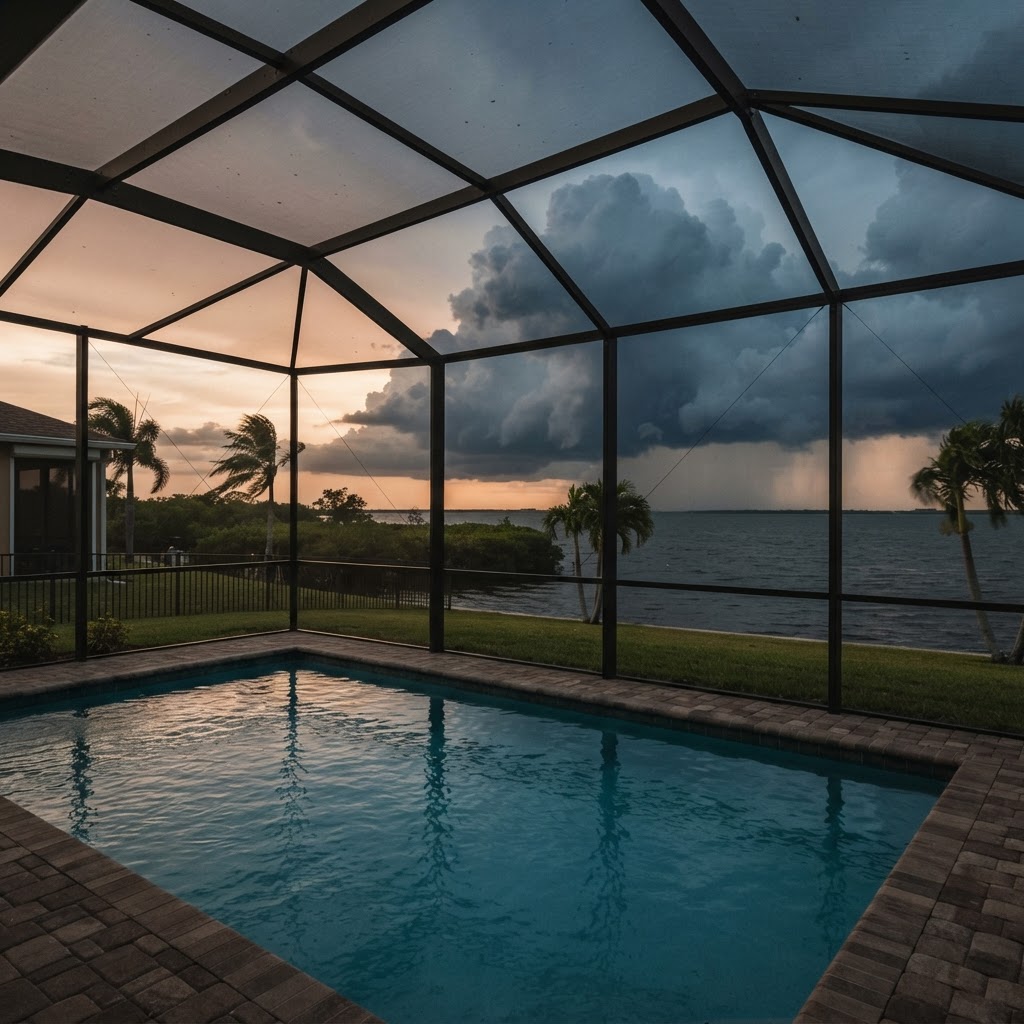
For most homes in Ruskin, Apollo Beach, Sun City Center, and Wimauma with a modern, permitted screen enclosure, the answer is no, do not cut your pool cage screens before a hurricane. Screen enclosures built to current Florida Building Code standards are engineered so the mesh tears out under extreme wind pressure, which relieves the load on the aluminum frame and helps it survive the storm. Cutting screens manually removes that designed pressure-release point. The exception is older, non-engineered cages with brittle screens, where strategic removal may make sense. Here is how to tell the difference and what to do before, during, and after a storm in South Shore FL.
The Pool Cage Hurricane Prep Question Every South Shore Homeowner Asks
Every September, the Facebook groups light up with the same debate: should you cut your pool cage screens before a hurricane? Some neighbors swear by it. Others say leave them alone. The conflicting advice comes from the fact that the right answer depends on how old your enclosure is and whether it was built to current Florida Building Code wind load standards.
Modern hurricane-rated screen enclosures work differently than most people think. The screen mesh is the weakest link by design. When wind pressure builds across the screened panels, the mesh pulls out of the spline groove or tears in a relatively uniform pattern, letting wind pass through the open frame. The aluminum structure, now acting like an open skeleton, experiences far less wind force than a solid wall would. That is how a well-built cage survives a Category 3 or 4 storm with frame intact and screens gone.
Older cages, especially those built before the 2002 Florida Building Code rewrite that followed Hurricane Andrew, were rarely engineered for specific wind loads. Their connections are weaker, their fasteners are often corroded, and screens that stay intact in a storm can create enough wind load to buckle columns or pull base plates out of the concrete. For those cages, cutting or removing screens can reduce the force on the structure.
When Screen Removal Actually Makes Sense
You should consider cutting or removing screens only in these specific situations:
- Your cage is more than 20 years old and shows visible corrosion at the base plates, beam connections, or fasteners
- The screen mesh is brittle, discolored, or already torn in multiple places, which means it will fail unevenly and leave partial panels that catch wind like sails
- Your home sits on the waterfront in Apollo Beach or Ruskin with direct exposure to Tampa Bay, and a Category 3 or stronger storm is forecast to make landfall within 24 hours
- The enclosure was never permitted or engineered and has already lost screens in previous storms
If any of these apply, the safest approach is to remove mesh panels from the windward side (typically the east or southeast face in a typical South Shore storm track) rather than blindly slashing every panel. Remove screen doors and lay them flat. Photograph everything before and after for insurance.
For any enclosure built after 2002 with a valid Hillsborough County permit and intact fasteners, leave the screens alone. The structure was designed for this.
Hillsborough County Wind Load Standards for Screen Enclosures
Hillsborough County requires screen enclosures to meet specific wind load ratings depending on location:
- Inland South Shore (Sun City Center, Wimauma, eastern Riverview): 140 mph Vult (ultimate design wind speed)
- Near Tampa Bay (Ruskin, Apollo Beach, waterfront parcels): 150 mph Vult or higher
- High-Velocity Hurricane Zone rules (170+ mph): These apply in Miami-Dade and Broward, not in Hillsborough County, but the exposure category for homes on open water increases the calculated pressure on the structure regardless
What this means: a cage built to 150 mph standards in Apollo Beach is engineered to survive a design-level storm with screens in place. The mesh is the sacrificial layer. The frame is the investment.
If you do not know your enclosure's wind load rating, check your original permit with Hillsborough County's online permit search or call the contractor who installed it. Enclosures built without permits do not have this engineering, which is why the advice to cut screens applies differently to them.
Pre-Storm Checklist for Your Screen Enclosure
Start 48 hours before expected tropical storm-force winds:
- Inspect fasteners. Check every beam-to-column connection and base plate for loose or missing screws. Replace any stripped fasteners with the same size and type. Do not use longer screws than the originals, which can bottom out and reduce holding strength.
- Clear the cage. Remove all furniture, grills, pool floats, planters, and decor from inside the enclosure. Anything loose becomes a projectile in 100 mph winds.
- Secure doors and gates. Verify that all screen door latches close and lock fully. Prop double doors closed from both sides. A door that blows open in a storm acts as a wind funnel.
- Trim nearby branches. Cut any tree limbs within 10 feet of the enclosure roof. Palms are the biggest risk in South Shore neighborhoods, especially in older areas of Ruskin and Sun City Center where mature trees overhang pool cages.
- Document the condition. Walk the enclosure and photograph every side, every connection, and any existing tears. You need a "before" record for insurance, and it tells you what was already damaged versus what the storm caused.
After the Storm: What to Check and When to Call a Pro
Once winds drop below 35 mph and it is safe to go outside:
Check the frame first. Look at every base plate for pulled anchors or cracked concrete. Walk the perimeter and look for columns that have shifted out of plumb. Check roof beams for visible kinks, twists, or sagging. A frame that moved during the storm may look fine at a glance but have bent connections that will fail in the next one.
Check the screens second. Small tears can be patched. Panels that blew out entirely are normal and expected on a well-built cage. What you are looking for is screens that tore in a way that pulled the spline out of the groove or damaged the aluminum channels, which is a sign the frame took load it should not have.
When to call a professional: - Any column leaning more than an inch out of plumb - Roof beams with visible kinks or twists - Multiple base plates lifted or cracked - Welds separated at beam connections - Screens gone from more than two sides, suggesting the frame may have flexed beyond design limits
Insurance documentation: Take photos of every damaged area, including the concrete at the base plates. Find your original permit number through the Hillsborough County permit portal if you can. Most homeowners policies cover wind damage to screen enclosures, but they require proof that the structure met code at the time of loss.
Pool Cage Repair Costs After a Storm in South Shore FL
Here is what storm-related screen enclosure work costs in the Ruskin, Apollo Beach, and Sun City Center area in 2026:
- Screen-only replacement (frame intact): $1,800 to $3,200 for a typical 30-by-40-foot cage, depending on mesh type and access
- Partial panel rescreening: $80 to $220 per panel
- Frame repair (some beams and columns): $6,000 to $14,000 depending on the extent of structural damage
- Full rescreen with hardware replacement: $3,500 to $6,500
- Hurricane-rated upgrades during repair (larger extrusions, additional tie-downs, stronger mesh): adds $2,500 to $4,500 to the repair cost but brings an older cage up to current code
When to Replace vs. Repair After Hurricane Damage
If your cage is more than 15 years old and was already showing wear before the storm, replacement is often the better financial decision. Repaired older cages still have the same corroded fasteners, undersized extrusions, and aging footings that failed in the first place. A second storm will test the same weak points.
New enclosures built to 150 mph Hillsborough County standards cost $18 to $28 per square foot installed, which for a typical South Shore pool cage means $18,000 to $28,000. That sounds steep compared to a $6,000 repair, but if you are repairing the same cage every other year, you will exceed replacement cost within two or three storm seasons and still have an enclosure that is not insurable at full value.
FAQ
Should I cut my pool cage screens before a hurricane?
For modern, permitted enclosures built to current Florida Building Code standards, no. The mesh is designed to tear away under high wind pressure and relieve the load on the frame. Cutting screens removes that engineered pressure-release mechanism. Only cut or remove screens if your cage is older than 20 years, has brittle mesh, or was built without engineering or permits.
How do I know if my pool cage is hurricane-rated?
Check your original building permit through the Hillsborough County online portal. If the enclosure was permitted after 2002, it should have engineering documents specifying the wind load rating (typically 140 or 150 mph Vult for South Shore). If there is no permit on record, assume the enclosure was not engineered and treat it as vulnerable in a storm.
Does homeowners insurance cover pool cage hurricane damage?
Most Florida homeowners policies cover wind damage to screen enclosures, but coverage limits and deductibles vary. You need proof that the enclosure met code at the time of loss, which means having the original permit and pre-storm photos. Some policies have separate, lower limits for screen enclosures (sometimes called "other structures" coverage). Check your policy before hurricane season starts.
What wind speed can a pool cage withstand in South Shore FL?
Enclosures built to current Hillsborough County code are engineered for 140 mph Vult inland (Sun City Center, Wimauma) and 150 mph Vult near Tampa Bay (Ruskin, Apollo Beach waterfront). The ultimate design wind speed represents a 700-year return period. Real-world performance depends on construction quality, maintenance, and whether the enclosure was modified after installation.
How soon after a storm should I repair my pool cage screens?
Within 30 to 45 days if the frame is intact. The South Shore climate means salt air and humidity begin corroding exposed fasteners and beam connections quickly once screens are gone. The longer the frame sits open, the more secondary damage accumulates. If the frame moved or bent, call a contractor immediately; do not rescreen a damaged frame.
Is a permit required for post-storm screen enclosure repairs?
Yes, for any structural work (beam replacement, column repair, base plate work) or full rescreening in Hillsborough County. Minor patch repairs under a certain size are often exempt, but confirm with Hillsborough County Building Services before starting. Unpermitted repairs can void insurance coverage and create problems when you sell the home.